Tirzepatide vs Semaglutide: Side-by-Side for Weight Loss
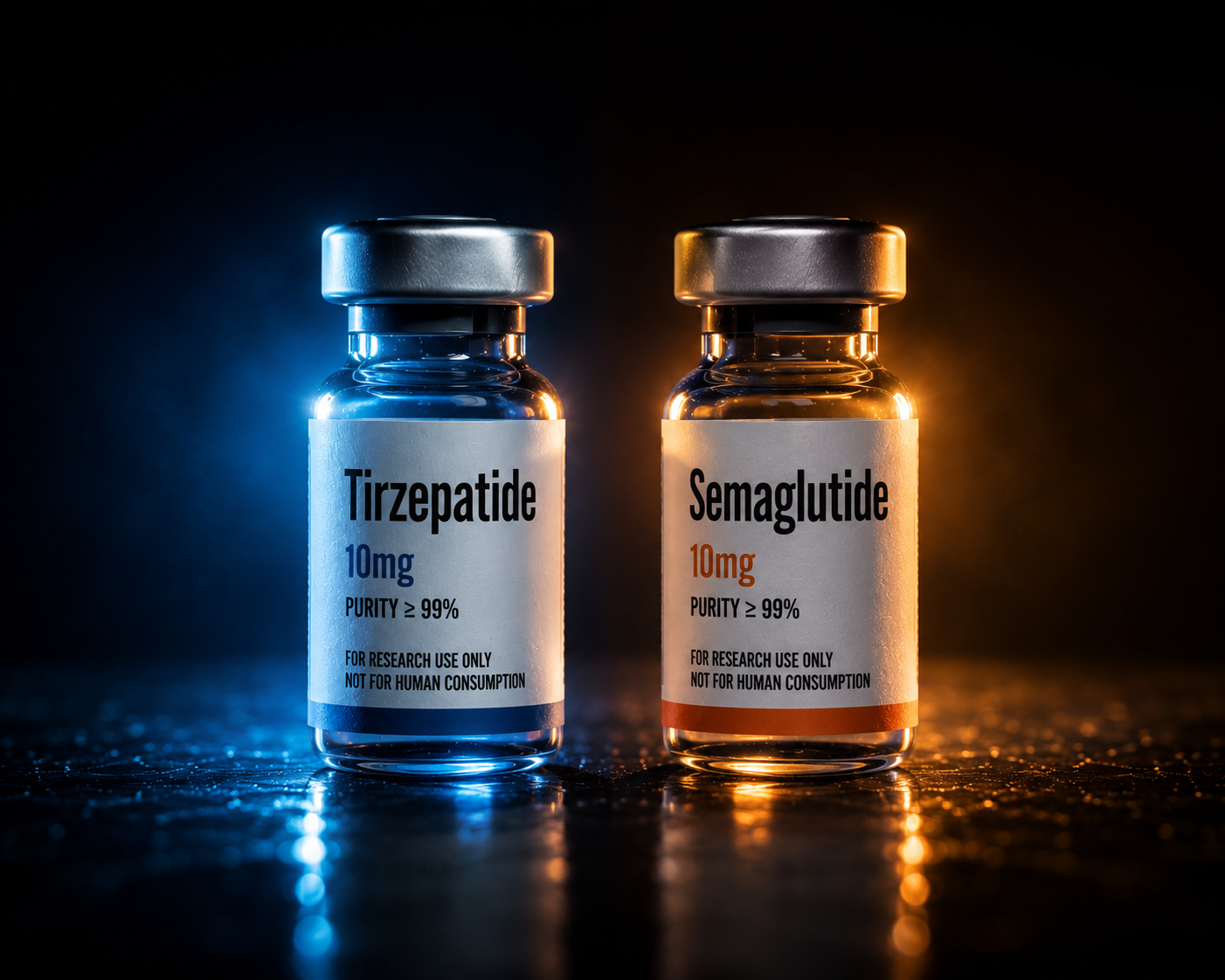
A comprehensive comparison of the two leading GLP-1 agonists for metabolic health and weight loss.
Educational content only. Not medical advice. The information below summarizes published clinical evidence and is not a substitute for consultation with a licensed healthcare provider.
Two drugs dominate the weight-loss conversation in 2026, and they get compared so often that the differences between them have started to blur in public discussion. Tirzepatide (Mounjaro, Zepbound) and semaglutide (Ozempic, Wegovy, Rybelsus) are both injectable peptide-based medications, both administered once weekly, both producing weight loss that exceeds anything pharmaceuticals could offer ten years ago. But they're not the same drug. They don't work the same way. And the head-to-head clinical data is now clear enough to make informed comparisons.
This guide walks through what's actually established — mechanism, efficacy, side effect profiles, dosing protocols, cost, and the situations where one tends to be the better fit than the other.
The 30-Second Answer
If you only have a minute: tirzepatide produces more weight loss on average than semaglutide. The 2025 SURMOUNT-5 head-to-head trial — published in The New England Journal of Medicine and the first direct comparison of the two drugs — found 20.2% average body weight reduction with tirzepatide versus 13.7% with semaglutide over 72 weeks. Side effect profiles are broadly similar (both cause GI symptoms, especially during dose escalation), but discontinuation rates trended slightly lower for tirzepatide.
That doesn't mean tirzepatide is the right choice for everyone. Cost, insurance coverage, side effect tolerance, and access to oral formulations (semaglutide has one; tirzepatide doesn't) all matter. The rest of this post explains why.
How They Work: Single vs Dual Action
Both medications are synthetic peptides that mimic naturally occurring incretin hormones — gut-derived signaling molecules that regulate appetite, glucose, and how quickly food moves through the digestive system.
Semaglutide is a GLP-1 receptor agonist. It binds to and activates a single receptor — the glucagon-like peptide-1 receptor — which slows gastric emptying, increases satiety signals to the brain, and improves insulin sensitivity. It was originally developed for type 2 diabetes (Ozempic, FDA-approved 2017) and later approved at higher doses for chronic weight management (Wegovy, 2021). An oral formulation also exists for diabetes (Rybelsus, 2019).
Tirzepatide is a dual GIP/GLP-1 receptor agonist. It activates the same GLP-1 receptor as semaglutide, plus a second receptor for glucose-dependent insulinotropic polypeptide (GIP) — another incretin hormone. The dual mechanism appears to produce additive effects on glucose regulation and appetite suppression. Tirzepatide was first FDA-approved for type 2 diabetes (Mounjaro, 2022) and then for chronic weight management (Zepbound, 2023).
The mechanistic difference is real, and it appears to translate to measurable clinical differences. But it's worth being precise: both drugs work primarily by reducing appetite and slowing gastric emptying. The dual receptor activity of tirzepatide isn't a fundamentally different category of action — it's a more comprehensive version of the same general approach.
The Head-to-Head: What SURMOUNT-5 Showed
For years, comparisons between tirzepatide and semaglutide had to rely on cross-trial inference — comparing results from the SURMOUNT trials (tirzepatide) against the STEP trials (semaglutide) despite different patient populations, study designs, and time windows. That changed with SURMOUNT-5.
SURMOUNT-5 (ClinicalTrials.gov NCT05822830) was the first direct head-to-head trial. Conducted from April 2023 through November 2024 across 32 U.S. and Puerto Rico sites, it enrolled 751 adults with obesity (BMI ≥30) or overweight (BMI ≥27 with at least one weight-related comorbidity), all without diabetes. Participants were randomized 1:1 to maximum tolerated doses of either tirzepatide (10 mg or 15 mg) or semaglutide (1.7 mg or 2.4 mg), administered once weekly for 72 weeks. The full results were published in The New England Journal of Medicine in 2025.
The primary endpoint was percent change in body weight at 72 weeks. The results:
- Tirzepatide group: average weight loss of 20.2% (about 22.8 kg / 50 lbs)
- Semaglutide group: average weight loss of 13.7% (about 15.0 kg / 33 lbs)
- Statistical significance: p < 0.001
- Patients achieving at least 25% body weight loss: 31.6% on tirzepatide vs 16.1% on semaglutide
- Waist circumference reduction: 18.4 cm (tirzepatide) vs 13.0 cm (semaglutide)
Tirzepatide met statistical superiority on the primary endpoint and on all five key secondary endpoints. The magnitude of difference — roughly 6.5 percentage points of body weight on average — is clinically meaningful, particularly when extrapolated across long durations.
A few important caveats. SURMOUNT-5 was open-label rather than blinded, which can introduce expectation effects. It excluded patients with diabetes, so the comparison applies to weight-loss patients without metabolic disease — the picture may differ for diabetic populations, where both drugs are studied separately. And the trial was not powered to compare safety outcomes head-to-head, only to confirm that safety profiles were consistent with previous SURMOUNT and STEP trials.
Side Effect Profiles: More Similar Than Different
Both drugs share essentially the same side effect profile because both engage the GLP-1 pathway, which directly influences GI motility. The most common adverse events for both:
- Nausea (most frequent, especially during dose escalation)
- Vomiting
- Diarrhea or constipation
- Decreased appetite (intended, but can become problematic at extremes)
- Abdominal pain
- Fatigue
- Injection site reactions
Most events are mild to moderate and concentrated in the dose-titration period during the first 8-16 weeks. After patients reach maintenance doses, GI symptoms typically diminish substantially.
Both medications carry similar regulatory warnings:
- Boxed warning for thyroid C-cell tumors based on rodent studies. Not contraindicated in humans but contraindicated in patients with personal or family history of medullary thyroid carcinoma or Multiple Endocrine Neoplasia syndrome type 2.
- Pancreatitis risk — patients with prior pancreatitis should be evaluated carefully.
- Gallbladder disease — both drugs increase risk of cholelithiasis, particularly during rapid weight loss.
- Hypoglycemia risk when combined with insulin or sulfonylureas (relevant for diabetic patients, less so for weight-only use).
In SURMOUNT-5, treatment discontinuation due to adverse events was 6.1% on tirzepatide and 8.0% on semaglutide. Discontinuation specifically due to GI side effects: 2.7% on tirzepatide versus 5.6% on semaglutide. The numerical advantage for tirzepatide on tolerability is small but consistent across trials.
Dosing and Titration
Both drugs require slow titration to minimize GI side effects. Starting at the target dose without ramp-up causes intolerable nausea in most patients.
Semaglutide (Wegovy) titration for weight loss:
| Week | Dose |
|---|---|
| 1-4 | 0.25 mg weekly |
| 5-8 | 0.5 mg weekly |
| 9-12 | 1.0 mg weekly |
| 13-16 | 1.7 mg weekly |
| 17+ | 2.4 mg weekly (maintenance) |
Tirzepatide (Zepbound) titration for weight loss:
| Week | Dose |
|---|---|
| 1-4 | 2.5 mg weekly |
| 5-8 | 5.0 mg weekly |
| 9-12 | 7.5 mg weekly |
| 13-16 | 10.0 mg weekly |
| 17-20 | 12.5 mg weekly |
| 21+ | 15.0 mg weekly (maintenance) |
Note that the milligram numbers between drugs are not comparable — they're entirely different molecules with different potencies. Tirzepatide's higher milligram doses don't mean it's "more" of anything; they reflect the structural differences in how the drug binds to its receptors.
Both protocols share the principle that the body adapts to GI effects over time, and that going slowly through titration is the single most important factor in successful long-term tolerance. Patients who pressure their physicians to skip titration steps usually regret it within a week.
Cost and Access in 2026
Pricing for both drugs has remained high relative to most chronic medications. As of early 2026:
- Wegovy (semaglutide for weight loss): retail list price approximately $1,350/month without insurance.
- Zepbound (tirzepatide for weight loss): retail list price approximately $1,060/month without insurance.
- Ozempic and Mounjaro: similar list prices to their weight-loss counterparts but only FDA-approved for diabetes.
Insurance coverage for weight-loss indications remains inconsistent. Many commercial plans require prior authorization with documented obesity-related comorbidities, and Medicare historically has not covered weight-loss-only indications, though policy continues to shift. Patients without coverage often pursue compounded versions through specialty pharmacies — a category that exists in a separate and rapidly evolving regulatory environment that we cover in a separate post on the FDA category list.
For most patients, the practical cost decision isn't tirzepatide vs semaglutide — it's "what does my insurance cover, and what does my pharmacy actually have in stock." Both drugs have experienced supply shortages over the past two years, though availability has stabilized in 2026.
Who Should Choose What
There is no universal answer, but a few patterns emerge from the data:
Tirzepatide tends to be the stronger choice when:
- Maximum weight loss is the priority and other factors are equal
- Patient has had limited response to semaglutide previously
- Patient has type 2 diabetes alongside obesity (both drugs work for this, but tirzepatide has shown strong glycemic outcomes)
- GI tolerance is a concern (slightly lower discontinuation rates in head-to-head data)
Semaglutide tends to be the appropriate choice when:
- Insurance covers semaglutide but not tirzepatide
- Patient prefers or requires an oral option (Rybelsus exists for diabetes; no oral tirzepatide is approved)
- Patient has tolerated semaglutide well and is meeting goals
- Cost is the decisive factor and the patient cannot access tirzepatide
Either is reasonable when:
- The patient is new to GLP-1 therapy and either is accessible
- Insurance covers both
- Weight loss goals are moderate (10-15% body weight reduction)
The single most important variable is consistency. The most effective drug is the one a patient can actually obtain, afford, and tolerate long enough to reach a maintenance dose. A 13.7% weight loss with semaglutide is enormously better than a 20.2% theoretical weight loss with tirzepatide that gets abandoned in week 6 due to cost or side effects.
Managing Your Peptide Protocol with PepOS
Whichever protocol you and your healthcare provider land on, the operational challenge is the same: track every weekly dose, manage vial inventory and expiration dates, monitor side effects across the titration window, and correlate your weight loss against your actual adherence and any biomarkers you're following.
PepOS is designed for exactly this. The dose calculator handles the reconstitution math automatically for either drug. The Apple Health integration overlays your weight and biometric trends against your protocol timeline. Peppy — our AI assistant — answers questions about your specific protocol with citations to primary literature. And the inventory tracker tells you when you're running low so you don't miss a week.
Start your first protocol free — track unlimited doses on the free tier, with the dose calculator and Apple Health sync included.
Sources Cited
-
Aronne LJ, et al. Tirzepatide as Compared with Semaglutide for the Treatment of Obesity. New England Journal of Medicine. 2025. (SURMOUNT-5 trial, ClinicalTrials.gov NCT05822830)
-
Jastreboff AM, et al. Tirzepatide Once Weekly for the Treatment of Obesity. New England Journal of Medicine. 2022;387(3):205-216. (SURMOUNT-1 trial)
-
Wilding JPH, et al. Once-Weekly Semaglutide in Adults with Overweight or Obesity. New England Journal of Medicine. 2021;384(11):989-1002. (STEP-1 trial)
-
U.S. Food and Drug Administration. Zepbound (tirzepatide) prescribing information. Updated 2024.
-
U.S. Food and Drug Administration. Wegovy (semaglutide) prescribing information. Updated 2024.
-
American College of Cardiology. SURMOUNT-5: Greater Loss of Weight, Waist Circumference With Tirzepatide Than Semaglutide. Journal Scan summary, January 2026.