Plain-English Guide to the FDA's New Peptide Category List

Breaking down the complex regulatory categories into simple terms for everyday biohackers.
Educational content only. Not medical advice. This post summarizes federal regulatory frameworks as they exist at the time of writing and does not constitute legal or clinical guidance.
If you've spent any time in peptide therapy over the past three years, you've heard about "Category 2" — the FDA list that pulled most popular peptides off the shelves of compounding pharmacies in late 2023. You've also heard, more recently, that "Category 2 is going away" or that "BPC-157 is legal again." Both statements are partially true and partially misleading. This guide explains what's actually going on.
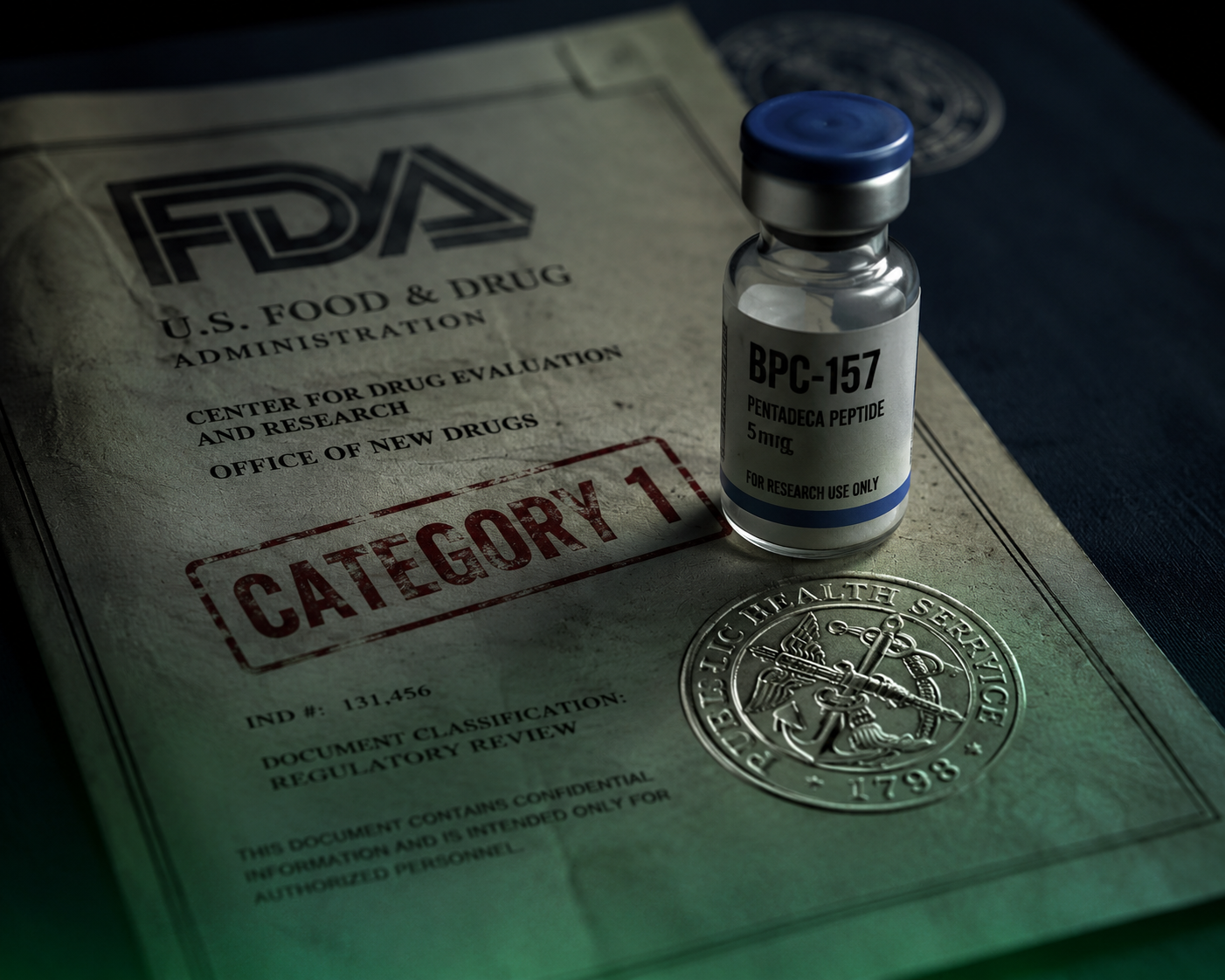
The short version: there are two FDA-defined categories that determine what compounding pharmacies can legally prepare. Category 1 means "permitted." Category 2 means "restricted." In February 2026, HHS Secretary Robert F. Kennedy Jr. announced that approximately 14 of the 19 peptides previously placed in Category 2 would be moved back to Category 1. The formal FDA publication codifying this change is still pending as of writing, but the regulatory direction is set.
The rest of this post covers what the categories mean, what's moving where, what's staying restricted, and what that means in practical terms.
What Are These Categories, Exactly?
The categories come from the 503A bulk drug substances framework. 503A is the section of the Food, Drug, and Cosmetic Act that governs compounding pharmacies — the licensed facilities that prepare custom medications from raw ingredients ("bulk drug substances") for individual patients with a physician's prescription. This is distinct from manufactured pharmaceutical drugs, which go through FDA new drug approval (NDA) processes.
For a bulk drug substance to be lawfully used in 503A compounding, it generally needs to be either:
- The active ingredient of an FDA-approved drug
- On the official USP/NF monograph list
- On the FDA's published 503A Bulk Drug Substances List
The 503A Bulk Drug Substances List is divided into categories. The two relevant ones for peptides are:
- Category 1: Bulk drug substances the FDA has reviewed and determined may be used in 503A compounding pending final inclusion on the list. In practical terms, these can be compounded today.
- Category 2: Bulk drug substances the FDA has identified as raising significant safety concerns. These cannot be lawfully compounded for use in patients while the designation stands.
There are other categories (Category 3 for substances under review, plus older legacy designations), but Categories 1 and 2 are where peptides live.
What Got Restricted in 2023 — and Why
In September 2023, the FDA placed 19 peptides on the Category 2 list. The agency's stated rationale centered on two concerns:
- Insufficient large-scale human safety data. Most peptides in question had robust preclinical evidence but limited Phase 3-quality human trials.
- Theoretical immunogenicity risk. Peptides can potentially trigger immune responses, and some of the restricted peptides had structural features that raised this concern in principle.
The practical effect was severe. Compounds that had been compounded for years — BPC-157, Thymosin Alpha-1, AOD-9604, GHK-Cu, Selank, Semax, and others — became suddenly unavailable through licensed pharmacies. Patients and prescribers who had built protocols around these compounds had no legal access. A substantial gray market emerged, with "research use only" suppliers filling demand outside any quality framework.
The Category 2 designation was contested almost immediately. Legal challenges argued that the FDA had not identified specific safety signals in real-world use to justify removing compounds with established clinical track records. Compounding pharmacy associations, clinicians, and patient advocates pushed for reconsideration.
What Changed in February 2026
On February 27, 2026, HHS Secretary Robert F. Kennedy Jr. announced — initially during an appearance on the Joe Rogan Experience podcast — that approximately 14 of the 19 Category 2 peptides would be reclassified back to Category 1 status. The announcement reflected a policy shift in how HHS was approaching the balance between patient access through regulated pharmacy channels versus the unregulated gray market that the Category 2 designation had inadvertently expanded.
As of late April 2026, the formal FDA publication implementing the reclassification is still pending. The expectation is that it will appear within the next several months. The announcement itself does not have the legal force of the published list — the FDA publication is what officially restores compounding authorization. But regulatory direction is clear.
Which Peptides Are Moving — Best Current Understanding
Based on the February 2026 announcement and subsequent analysis by compounding pharmacy associations and regulatory experts, the following peptides are expected to return to Category 1 status:
Healing and recovery:
- BPC-157 (Body Protection Compound-157)
- TB-500 (Thymosin Beta-4)
- KPV (anti-inflammatory tripeptide)
- GHK-Cu (Copper Tripeptide)
- Pentadeca Arginate
Growth hormone secretagogues and related:
- CJC-1295 (with and without DAC)
- Ipamorelin
- Sermorelin
- Tesamorelin (already FDA-approved as Egrifta)
Immune and metabolic:
- Thymosin Alpha-1
- AOD-9604
- MOTS-c
Cognitive:
- Selank
- Semax
The exact final list will be published by the FDA. Several compounds remain disputed in pre-publication analysis — CJC-1295's status in particular has been characterized differently by different sources.
Which Peptides Are Staying Restricted
The remaining 5 of the original 19 are expected to stay on Category 2. The compounds most commonly cited:
- Melanotan II — alpha-melanocyte stimulating hormone analog. Concerns include reports of accelerated melanoma in case studies and significant cardiovascular effects.
- GHRP-2 and GHRP-6 — growth hormone releasing peptides associated with elevated cortisol and prolactin in clinical use.
- LL-37 — antimicrobial peptide with very limited human safety data.
- PEG-MGF — pegylated mechano growth factor with minimal clinical evidence.
These remain unavailable through licensed compounding pharmacies. Any suppliers selling them outside that framework operate in gray-market territory.
What This Actually Means for Patients
Several practical points are worth being clear about:
Category 1 status restores legal compounding access, but it does not make these peptides FDA-approved drugs. The compounds returning to Category 1 are still being prescribed off-label for indications that have not gone through FDA approval. Physicians prescribing them are doing so based on accumulated clinical evidence and observational experience, not on the basis of FDA-approved indications.
A physician's prescription is still required. Over-the-counter availability is not part of the reclassification. Anyone selling these peptides without requiring a prescription is operating outside the legal framework, regardless of how the product is labeled.
Quality differs substantially between compounding pharmacies and gray-market sources. Licensed 503A compounding pharmacies operate under USP 797 and 795 standards — sterility testing, controlled raw materials, documented processes. Research-chemical suppliers do not. Independent testing has repeatedly found gray-market peptides with incorrect dosages, contamination, or in some cases entirely different compounds than labeled. The return to Category 1 access matters in part because it gives patients a quality-controlled option that didn't exist for two years.
Insurance coverage typically does not extend to compounded peptides because they are not FDA-approved drugs. Patients generally pay out of pocket. Prices vary by pharmacy and protocol but are commonly in the $150-$500/month range depending on the specific peptide and dosing.
The separate "supplement pathway" question is unresolved. Some advocates have argued for classifying certain peptides as dietary supplements under DSHEA, which would bypass the prescription requirement entirely. This is a separate regulatory track from the 503A categorization and has not advanced as of April 2026.
What This Means If You Were Using a Gray-Market Source
If you've been obtaining BPC-157, Thymosin Alpha-1, or any of the returning compounds from a research-chemical supplier, the reclassification gives you a clearly superior option. Working with a physician to obtain pharmacy-compounded versions costs more than gray-market alternatives, but the quality difference is substantial: verified sterility, accurate dosing, no risk of contamination, and proper handling.
The transition is straightforward in concept: find a physician who works with peptide therapy (often functional medicine practitioners, integrative medicine, or longevity-focused clinics), discuss your current protocol and goals, and obtain a prescription that can be filled at a licensed 503A compounding pharmacy. Many physicians who work in this space have established compounding pharmacy partnerships and can streamline the process.
What's Next on the Regulatory Front
A few things to watch over the rest of 2026:
- Formal FDA publication of the updated Category 1/2 list. This is what makes the reclassification legally operative.
- Potential supplement pathway proposals for specific compounds. Whether any peptides move to dietary supplement regulation is unresolved.
- Additional 503B (outsourcing facility) considerations. 503B facilities, which can produce compounded medications in larger batches without individual prescriptions, operate under different rules. Whether returning Category 1 peptides will be available through 503B channels is a separate question.
- State-level prescription requirements. Some states have additional restrictions on which compounded medications can be prescribed and by whom. The federal reclassification doesn't automatically override state-level rules.
Managing Your Protocol with PepOS
If you're starting or restarting a protocol that uses one of the returning compounds, PepOS handles the operational details: tracking each dose, calculating reconstitution math automatically, monitoring inventory and expiration dates, and overlaying your protocol against your Apple Health metrics so you can see whether it's actually working. The AI assistant, Peppy, can answer protocol-specific questions with citations to primary literature — including the regulatory and clinical context referenced in this post.
Sources Cited
-
Kennedy RF Jr. Public statement on FDA peptide reclassification. Joe Rogan Experience episode #2461, February 27, 2026.
-
FDA. 503A Compounding Bulks List — Categories 1 and 2. fda.gov, updated continuously.
-
Food, Drug, and Cosmetic Act, Section 503A. Pharmacy Compounding of Human Drug Products Under Section 503A of the Federal Food, Drug, and Cosmetic Act. 21 U.S.C. § 353a.
-
United States Pharmacopeia. USP 795 (Pharmaceutical Compounding — Nonsterile Preparations) and USP 797 (Pharmaceutical Compounding — Sterile Preparations).
-
Sikiric P, et al. The Stable Gastric Pentadecapeptide BPC 157 Pleiotropic Beneficial Activity and Its Possible Relations with Neurotransmitter Activity. PMC11053547, 2024.
Have a specific peptide you're trying to figure out the status of? Open Peppy in the PepOS app — protocol-specific guidance grounded in primary literature.