What Happened to BPC-157? The 2026 FDA Reclassification Explained
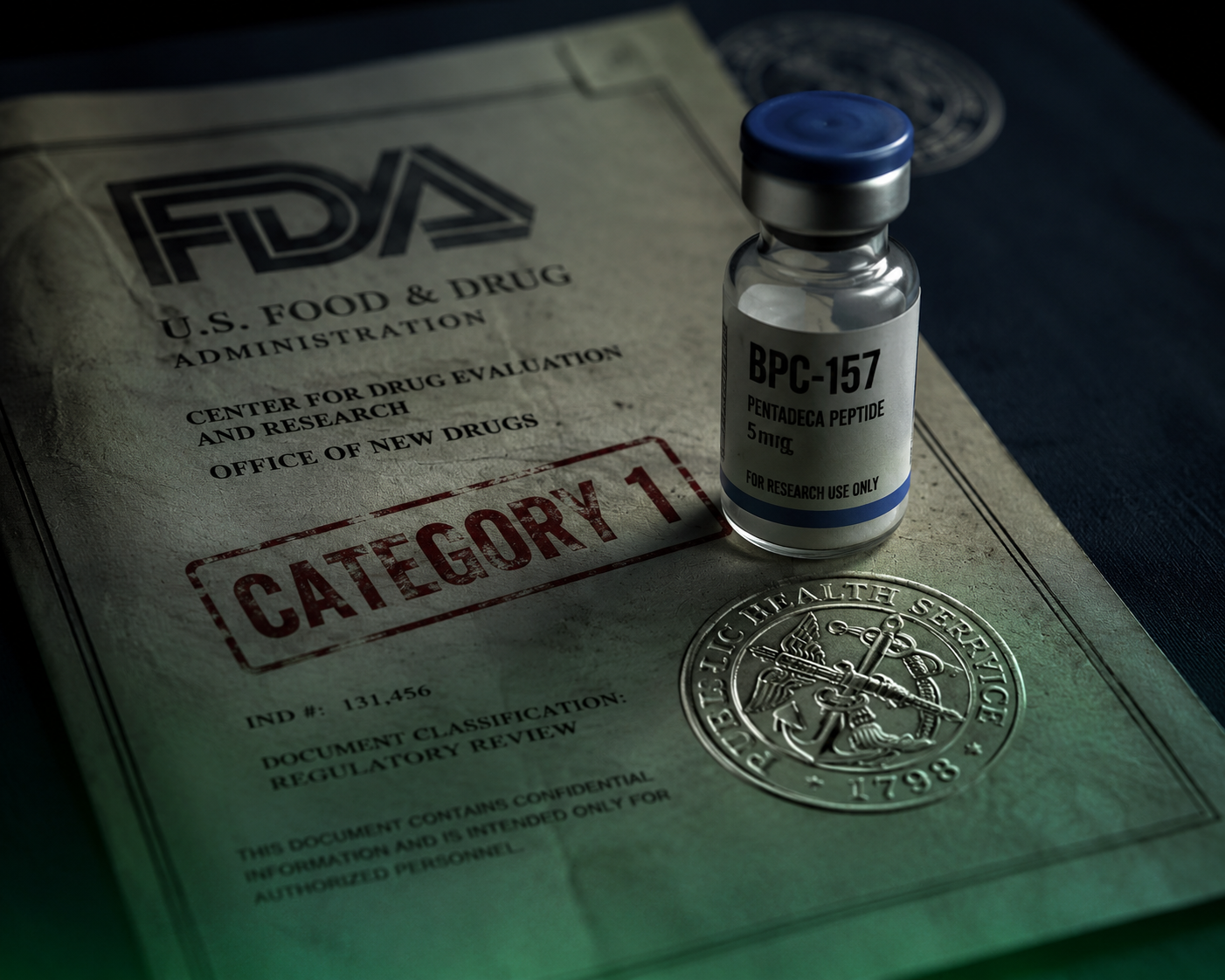
A detailed look into the latest FDA regulatory changes affecting BPC-157 and what it means for users.
Educational content only. Not medical advice. Current as of May 2026. Regulatory status continues to evolve and this post will be updated as the formal FDA publication appears.
If you've followed BPC-157 in any depth over the past three years, you've watched a regulatory whiplash. Widely prescribed through licensed compounding pharmacies before late 2023. Restricted to the FDA's "do not compound" list from late 2023 through early 2026. Now expected to return to legal compounding status following Secretary Kennedy's February 2026 announcement.
This post is the short version of that story: what happened, why it happened, and what it means for anyone who uses or is considering BPC-157.
For the comprehensive guide to BPC-157 itself — mechanism, evidence base, dosing, stacks, safety — see our BPC-157 Complete Protocol Guide. This post focuses specifically on the regulatory narrative.
Where BPC-157 Sat Before 2023
For roughly two decades before the 2023 restriction, BPC-157 had been available in the United States through licensed 503A compounding pharmacies with a physician's prescription. The compound itself was synthesized from research originally conducted at the University of Zagreb in the 1990s. By the mid-2010s it had become a relatively common off-label prescription in functional medicine, sports medicine, and longevity-focused clinical practices — particularly for soft-tissue injury recovery and gastrointestinal indications.
Importantly, "available through compounding pharmacies" is not the same as "FDA-approved." BPC-157 has never had an FDA-approved indication. The compounding pathway permits licensed pharmacies to prepare bulk drug substances for individual patients with valid prescriptions — a different regulatory mechanism than the new drug approval process that produces FDA-approved pharmaceuticals.
In practice, this distinction matters but is sometimes blurred in public discussion. Patients who received BPC-157 prescriptions in 2019 were doing so within a legal compounding framework, even though the compound itself wasn't an "approved drug" in the regulatory sense.
What Happened in September 2023
In September 2023, the FDA placed BPC-157 — along with 18 other peptides — on its Category 2 list under the 503A bulk drug substances framework. Category 2 designation means the FDA has identified safety concerns significant enough to prevent the substance from being used in 503A compounding. The practical consequence: compounding pharmacies could no longer legally prepare BPC-157, even with a physician's prescription.
The agency's stated rationale centered on two concerns:
- The absence of large-scale human safety studies. Most BPC-157 research is preclinical (animal studies) with limited human clinical trials. The FDA considered the human safety data insufficient to support continued compounding.
- Theoretical immunogenicity concerns. Peptides can potentially trigger immune responses. BPC-157's specific structural features were cited as raising this concern in principle, though no clinical case reports of immunogenicity issues had been published.
The decision was controversial from the moment it was announced. Critics pointed out that the FDA had not identified any specific safety signal from years of compounded use — no reports of serious adverse events, no clusters of unexpected outcomes, nothing in the way of clinical signals that would normally justify a restriction of this severity. Industry analysts characterized the restriction as based on absence of data rather than presence of harm.
The clinical community responded predictably. Patients with established protocols suddenly lost access to a treatment many had been using for years. Physicians who had been prescribing BPC-157 had to redirect patients or refuse continued treatment. And — most consequentially from a public health standpoint — a substantial gray market emerged to fill demand.
The Gray Market That Followed
Within months of the Category 2 designation, BPC-157 was widely available through "research chemical" suppliers. These vendors sold the peptide labeled "for research use only, not for human consumption" — a regulatory fiction that everyone involved understood. The actual customers were patients buying the same compound they'd previously obtained through compounding pharmacies, now without quality control, without sterility testing, and without physician oversight.
The quality concerns were not theoretical. Independent third-party testing during 2024-2025 repeatedly found gray-market peptides with significant problems:
- Incorrect dosing — vials labeled 5 mg containing anywhere from 2 mg to 8 mg of actual peptide
- Contamination with bacterial endotoxins, heavy metals, or solvent residues
- Some cases of completely different compounds substituted for the labeled product
- Inconsistent purity grades across batches from the same supplier
Patients who had been obtaining clean, properly dosed BPC-157 through compounding pharmacies were now navigating a market where the product they received was substantially less reliable. The Category 2 designation, intended to protect patients from theoretical safety concerns, had pushed many of those patients into actually riskier supply chains.
This irony was widely noted, including in academic commentary, industry analysis, and eventually in public statements from the regulatory side itself. By 2025, the question of whether the Category 2 designations had achieved their stated safety goals was increasingly disputed.
February 27, 2026: The Reclassification Announcement
On February 27, 2026, HHS Secretary Robert F. Kennedy Jr. — appearing on the Joe Rogan Experience podcast — announced that approximately 14 of the 19 Category 2 peptides would be moved back to Category 1 status. BPC-157 was named explicitly as among the compounds returning.
Kennedy's stated framing reflected an explicit acknowledgment that the Category 2 designations had created the gray market they were intended to prevent. The reclassification, in his framing, was a recognition that regulated access through licensed pharmacies — with USP 795 and 797 compliance, sterility testing, and pharmaceutical-grade raw materials — was safer than the alternative that the restriction had inadvertently expanded.
A few important nuances about the announcement:
An announcement is not a formal FDA publication. Secretary Kennedy's statements signal regulatory direction but do not by themselves restore legal compounding authorization. The FDA must formally publish the updated Category 1/2 list, and as of May 2026, that publication has not yet appeared. The expectation is that it will follow within months, but until it does, the technical legal status of BPC-157 remains Category 2.
The reclassification does not make BPC-157 an FDA-approved drug. Category 1 means it can be lawfully compounded — not that the FDA has approved it as a treatment for any specific condition. Physicians prescribing BPC-157 are still doing so off-label, based on clinical experience and preclinical evidence.
A physician's prescription will still be required. Over-the-counter availability is not part of the reclassification. Anyone selling BPC-157 without requiring a prescription is operating outside the legal framework, both now and after the formal reclassification.
What This Means Right Now (May 2026)
The practical situation as of this writing:
- Formal legal compounding of BPC-157 remains technically unauthorized until the FDA publishes the updated category list.
- Many compounding pharmacies and prescribing physicians are preparing for the change by re-establishing supply chains, raw material sources, and clinical protocols.
- Patients who have been using gray-market sources can begin transitioning conversations with physicians now, with the expectation that legal pharmacy-compounded supply will be accessible in the coming months.
- Patients new to BPC-157 should understand that the most defensible time to begin is after the formal FDA publication, through a physician working with a licensed compounding pharmacy.
How to Find a Prescribing Physician
When the formal reclassification appears, the physician populations most likely to prescribe BPC-157 are:
- Functional medicine practitioners
- Integrative medicine clinics
- Sports medicine physicians (particularly those who work with high-performance athletes outside WADA-tested populations)
- Longevity-focused clinics
- Some primary care providers in regions with established peptide therapy practices
Telehealth platforms specializing in peptide therapy expanded substantially after 2023 (initially to fill the gap created by the restriction) and many are positioned to facilitate access when the reclassification formalizes.
Managing Your BPC-157 Protocol with PepOS
Whether you're returning to BPC-157 after the reclassification or starting a new protocol, PepOS handles the operational details: reconstitution math, dose tracking, vial inventory, and side effect monitoring. The Apple Health integration overlays your protocol timeline against your recovery metrics. Peppy, the AI assistant, can answer protocol-specific questions grounded in primary literature.
Start free at app.pepos.app — track unlimited doses on the free tier.
Sources Cited
-
Kennedy RF Jr. Public statement on FDA peptide reclassification. Joe Rogan Experience episode #2461, February 27, 2026.
-
FDA. 503A Compounding Bulks List — Categories 1 and 2. fda.gov, updated continuously.
-
Food, Drug, and Cosmetic Act, Section 503A. Pharmacy Compounding of Human Drug Products Under Section 503A of the Federal Food, Drug, and Cosmetic Act. 21 U.S.C. § 353a.
-
Sikiric P, et al. The Stable Gastric Pentadecapeptide BPC 157 Pleiotropic Beneficial Activity and Its Possible Relations with Neurotransmitter Activity. PMC11053547, 2024.
-
For the full BPC-157 evidence base and protocol guide, see our BPC-157 Complete Protocol Guide.
This post will be updated when the formal FDA reclassification publication appears.